About
Who is Dr. David Maglakelidze?
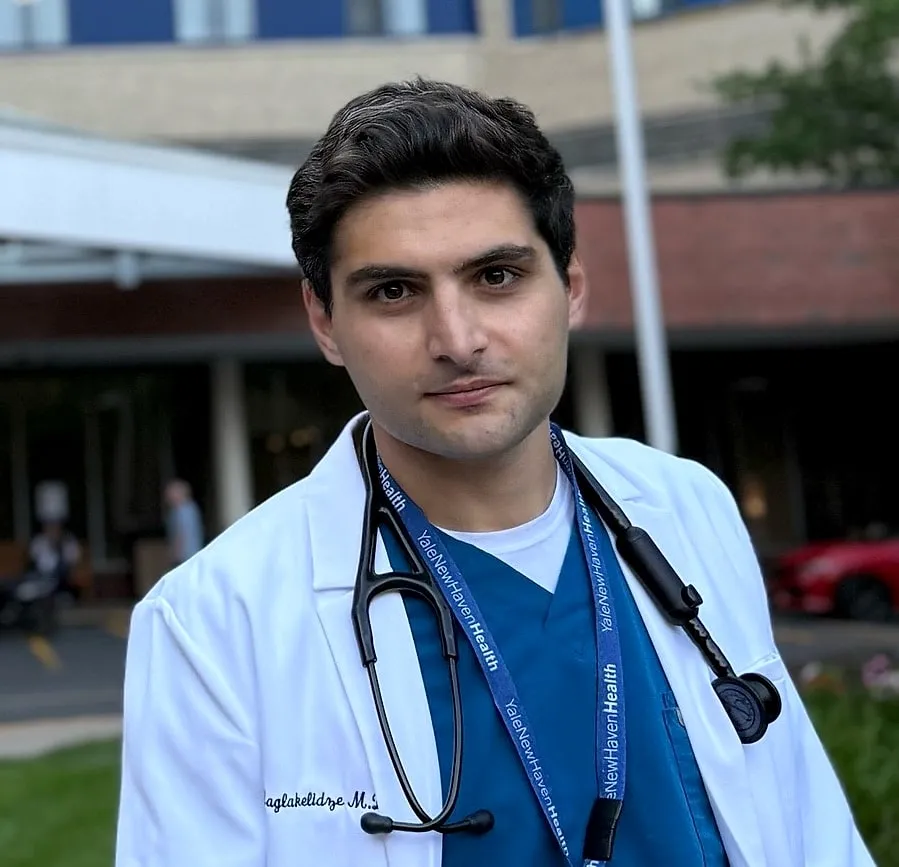
I'm David Maglakelidze, MD, and most patients end up calling me "Dr. Mag". I am a board-certified internal medicine physician at Yale New Haven Hospital, with a particular focus on obesity medicine and metabolic health, and I am building a personalized, membership-based primary care practice in Brooklyn, New York. It rests on a simple conviction: medicine works best when your doctor truly knows you, has time for you, and answers when you call.
Training
I am board-certified in internal medicine by the American Board of Internal Medicine (2023). I earned my medical degree at David Tvildiani Medical University's AIETI Medical School in Tbilisi, Georgia, and completed internal medicine residency training on two continents, first at Tbilisi State Medical University, then at NYC Health + Hospitals / Coney Island in Brooklyn, New York, a 371-bed safety-net hospital where residency means everything at once: the ICU, codes, procedures, point-of-care ultrasound, and above all volume and variety of real human illness.
Along the way I trained beyond the wards: at the National Institutes of Health, I completed coursework in cancer prevention and control and molecular cancer prevention (2019, on an NIH scholarship), and earlier in my career I coordinated clinical trials, including a Phase IIb study in fatty liver disease and non-alcoholic steatohepatitis.
Yale New Haven Hospital
Since 2023 I have practiced as a full-time internal medicine attending physician at Yale New Haven Hospital, a major academic referral center affiliated with the Yale School of Medicine. My daily work is caring for medically complex patients, people admitted with several serious conditions at once: diabetes, hypertension, heart disease, kidney disease. I supervise and teach internal medicine residents and medical students, respond to rapid-response and code events, and serve on patient-safety committees, translating what I see at the bedside into system-level improvements.
Hospital medicine teaches you to hold the whole picture, because in a complex patient nothing exists in isolation. A medication that helps one problem can worsen another; a plan that looks right on paper can fail if it doesn't fit the person's actual life. That habit of seeing the whole person, and the judgment that comes from managing serious illness every day, is exactly what I want to bring to primary care.
While at Yale, I was honored as a Nominee, Young Physicians Leadership Academy, Yale, a nomination that reflected the part of medicine I care about most: how physicians communicate, lead, and build systems that actually serve patients.
Why primary care
Prevention has been the through-line of my career since before medical school ended. At the National Cancer Center of Georgia I coordinated the implementation of the national cancer registry, ran a tobacco-control program in schools, and volunteered in palliative care, work that taught me early how much suffering arrives decades after the missed chance to prevent it.
In the hospital, I meet the same story again and again. The heart failure, the kidney disease, the stroke: so often it began years earlier as a blood pressure that drifted, a blood sugar that crept up, a symptom nobody had time to chase. By the time I meet these patients, the window for the easy fix has usually closed. Primary care is where that window is still open, and where a doctor with time can actually change how the story ends.
Much of that story is metabolic. Weight, blood sugar, blood pressure, cholesterol, and liver health are one conversation, not five referrals, which is why obesity medicine has become a particular focus of mine. In my practice it is simply part of how I take care of you, there whenever you want it and never pressed on you when you don't.
Why I love this work
I should say plainly that I love being a doctor. Not the paperwork or the prior authorizations, but the actual practice of medicine: the puzzle of a presentation that does not quite fit, the moment someone's shoulders drop because a person finally explained what is happening inside their body, the long arc of watching someone get well and then stay well for years.
Medicine granted me a strange privilege, which is that people tell me true things. They tell me what frightens them, what they have not said out loud to anyone else, what they have been avoiding for two years and are now finally asking about. That trust is the most valuable thing I handle. It is worth building an entire practice specifically to protect it.
Three convictions shape how I work. Time is a clinical tool, not a courtesy; most diagnostic errors I have seen trace back to a conversation that ended too early. How something is explained is part of the treatment, because a plan a person does not understand is a plan that will not happen. And nobody should be reduced to a problem list, because the person in front of me always has more to do with the outcome than the diagnosis does.
How I practice
My core belief is that communication is a clinical skill, as consequential as any prescription. In my practice, visits are long enough to actually talk. You have direct access to your physician, not a portal that answers in three business days. Every decision is shared: I bring the evidence and my judgment; you bring expertise in your own life; the plan is something we build together.
If you have ever left an appointment feeling rushed, unheard, or reduced to a lab value, I built this practice for you.
Outside the clinic
I write about the questions patients actually ask: plain-language explanations of the science, the medications, and what good care looks like. You can read that work on the articles page, or see how I practice. I speak English, Georgian, and Russian, and away from the hospital you'll find me on a soccer pitch, a ski slope, or, best of all, spending time with my daughter.